




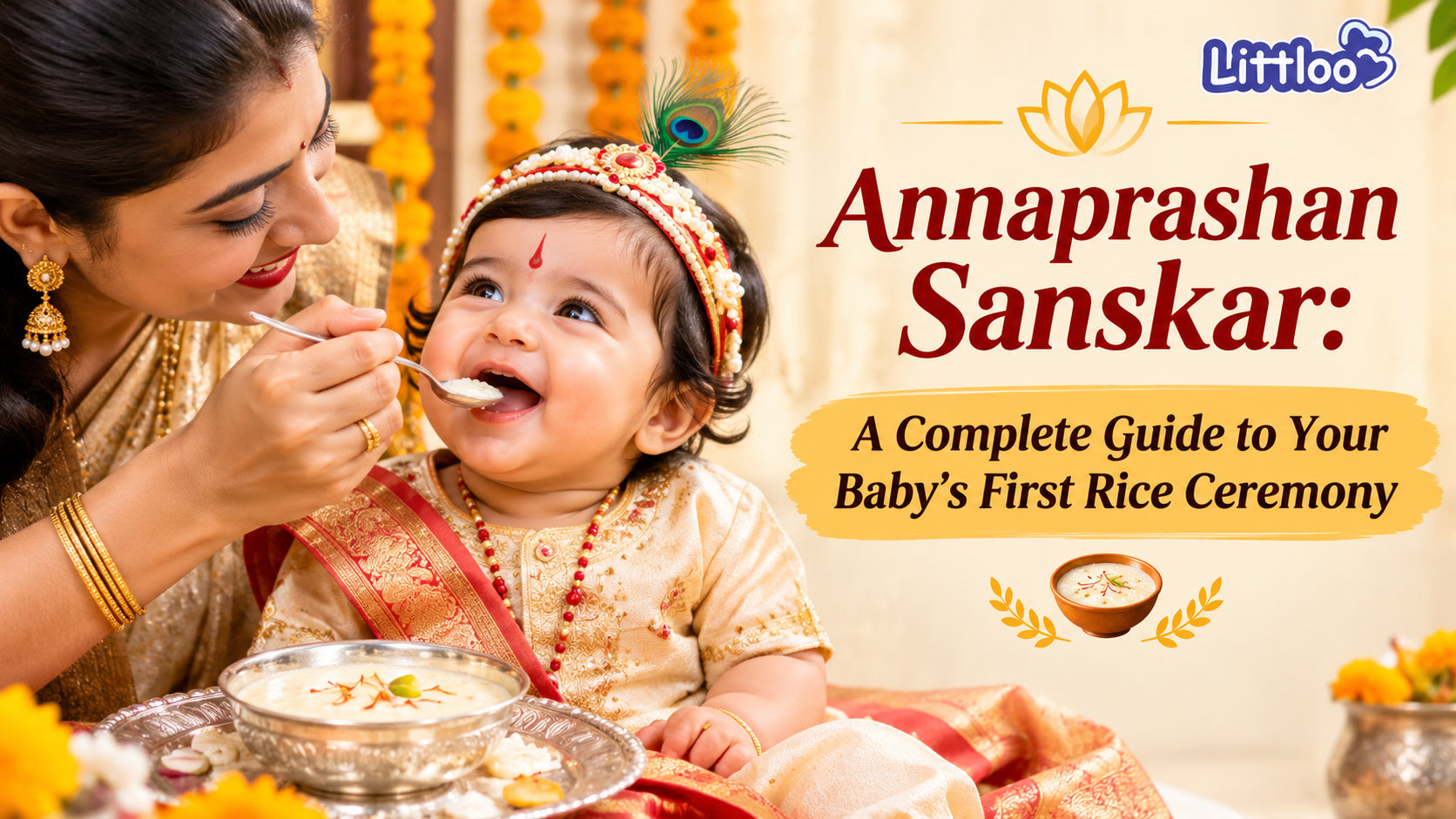
Annaprashan is the Hindu ceremony in which a baby is fed their first grain-based food, usually a little soft rice or a spoonful of kheer, at around six months of age. Also called the annaprashan sanskar or the first rice ceremony, it marks the moment your little one moves beyond milk and begins sharing the family’s food.
If your baby’s ceremony is coming up, you probably have practical questions. Which month is right? What happens during the rituals? What should your baby actually eat? And what makes a good gift? This guide covers all of it, with a step-by-step ritual order, regional traditions, baby-safe food swaps, a planning checklist and gift ideas.
Annaprashan at a glance
|
Question |
Quick answer |
|
What it means |
“Anna” (food or grain) + “prashan” (eating): the baby’s first feeding of solid food |
|
Also known as |
Rice ceremony, first rice ceremony, Mukhe Bhaat (Bengal), Choroonu (Kerala), Annaprasanam (South India), Pasni (Nepal) |
|
Typical age |
Around 6 months; some families follow odd months for girls and even months for boys |
|
Traditional first food |
Soft rice, kheer, payasam or payesh |
|
Who feeds the baby |
The father, grandfather or maternal uncle, depending on family custom |
|
Where it happens |
At home, at a temple or at a banquet venue |
What Is Annaprashan Sanskar?
Annaprashan is one of the sixteen sanskaras (Shodasha Samskaras), the rites of passage in Hindu tradition that mark key stages of life. In a baby’s first year it usually follows the naming ceremony (Namakarana) and the first outing (Nishkramana), and it comes before the first haircut (Mundan).
The word comes from Sanskrit: anna means food or grain, and prashan means feeding or eating. Rice is the usual choice because it turns soft when cooked, mashes easily and has long been linked with prosperity and nourishment in Indian homes. That is why the event is so widely known as the rice ceremony.
Why families still celebrate it
For many families, the ceremony is as much about togetherness as it is about faith. Elders bless the child, relatives meet the baby, sometimes for the first time, and the family formally welcomes the little one to the shared table.
The tradition also lines up neatly with modern feeding advice. The WHO recommends introducing complementary foods at 6 months (180 days) while breastfeeding continues, because milk alone gradually stops meeting all of a baby’s nutritional needs.
When Should You Do Your Baby’s Annaprashan Ceremony?
Traditional timing for boys and girls
Many families follow a long-standing custom: annaprashan for boys in an even month (often the sixth or eighth) and for girls in an odd month (often the fifth or seventh). Others simply hold the baby annaprashan around the six-month mark for every child. Customs differ between communities, so ask your family elders or priest what your family has traditionally followed.
Readiness signs matter more than the calendar
Whatever date you pick, make sure your baby is physically ready for a first taste of solids. Common signs include:
- Sits up with little or no support
- Holds the head and neck steady
- Opens the mouth when food comes close
- Shows interest when others are eating
- No longer pushes food straight back out with the tongue
If your family’s custom points to the fifth month, or your baby was born prematurely, talk to your paediatrician first. Many families in this situation keep the ritual symbolic, with just a gentle touch of kheer to the lips, and start regular solids a little later.
Choosing a muhurat
Families who follow the Hindu calendar usually ask a priest to choose an auspicious date and time (muhurat) based on the baby’s birth details. If you have a choice of slots, pick one that suits your baby’s routine. A mid-morning ceremony after a nap and a milk feed is usually far easier than one during a fussy late-evening stretch.
Annaprashan Rituals: What Happens, Step by Step
The exact order varies from family to family, but most annaprashan rituals follow a similar flow:
- Bath and dressing: The baby is bathed and dressed in new traditional clothes, often a dhoti-kurta for boys and a silk frock or pavadai for girls.
- Puja and sankalp: The family offers prayers, usually to Lord Ganesha first and then to the family deity. Some families also perform a small havan.
- Blessing the food: The rice or kheer is offered to the deity so it becomes prasad.
- The first bite: The father, grandfather or maternal uncle feeds the baby a tiny amount, often with a silver spoon, or with a silver coin or ring dipped in kheer.
- Blessings from elders: Elders place their hands on the baby’s head, and some apply tilak or bless the baby with paddy and durva grass.
- The object-choosing game: In many families, a few items are placed in front of the baby, such as a book, a pen, a little soil, money or jewellery. Whatever the baby reaches for is playfully said to hint at their future.
- Family meal: Guests share a festive meal while the baby is passed around for photos (and, ideally, a nap).
Expect your baby to eat very little. One or two tastes is completely normal. The ritual is symbolic, and the real food journey continues over the weeks that follow.
Annaprashan for Baby Girl: Traditions and Thoughtful Touches

An annaprashan for baby girl follows the same core rituals, but a few customs are often specific to daughters:
- Timing: Many families choose the fifth or seventh month, in line with the odd-month custom.
- Outfit: A silk pavadai, a lehenga-style frock or a Banarasi dress are popular choices. Look for a soft cotton lining so the fabric does not rub delicate skin.
- Ornaments: Grandparents often gift tiny silver anklets, bangles or a black-thread nazar bracelet. Put them on for photos and take them off afterwards, because small pieces can be a choking hazard.
- Symbolism: Some families see the ceremony as welcoming Lakshmi into the home and include a short Lakshmi puja.
Nothing about the ritual itself needs to change for a daughter. What matters most is a comfortable, well-rested baby and a relaxed family around her.
How the First Rice Ceremony Is Celebrated Across India
The first rice ceremony goes by different names and has different highlights depending on where your family comes from:
|
Region |
Local name |
What makes it distinctive |
|
West Bengal |
Mukhe Bhaat |
The maternal uncle (mama) traditionally feeds the baby. The baby’s thali often holds rice, dal, fish, vegetables and payesh, most of it as a symbolic offering. |
|
Kerala |
Choroonu |
Often held at a temple, with Guruvayur a well-known choice. The baby is fed rice with a little ghee or payasam. |
|
Tamil Nadu and Karnataka |
Annaprasanam |
Performed at a temple or at home, often with payasam or sweet pongal offered first to the deity. |
|
Odisha |
Annaprashana |
Kheer is a common first food, followed by a family feast. |
|
North India |
Annaprashan |
Usually an intimate home puja with kheer, followed by lunch for close family. |
|
Nepal |
Pasni |
Commonly held at five months for girls and six months for boys, with a symbolic taste from a large spread of dishes. |
What to Feed Your Baby at the Rice Ceremony
Traditional annaprashan menus can be elaborate, but your baby needs only a small, soft and safe taste. Here is how to keep the tradition while making it baby-friendly:
|
Traditional item |
Baby-safe version |
|
Kheer or payasam made with sugar |
Rice cooked very soft and mashed smooth, with no added sugar. A little mashed ripe banana adds natural sweetness. |
|
Honey on the tongue or in sweets |
Skip it completely until after the first birthday |
|
Salted rice, dal or curry |
Plain mashed rice or thin moong dal, with the baby’s portion set aside before salt and spices go in |
|
Whole grains of rice |
Overcooked, well-mashed rice with no firm grains |
|
Mithai, ladoo or rasgulla |
Keep these for the guests |
|
Ghee |
A drop or two stirred into the rice is traditional and suits most babies |
Foods to skip on the day
- Honey in any form before 12 months. Health authorities, including the CDC, warn that it can cause infant botulism.
- Added salt and sugar, including jaggery, in the baby’s portion
- Whole nuts, raisins and hard pieces, which are choking hazards
- Fruit juices and sweetened drinks
- Several new foods at once. If your baby reacts to something, you won’t know which food caused it.
Use a soft-tipped spoon for the first bite. A silicone baby spoon feeder is gentle on gums, and many families keep the traditional silver bowl for the ritual and switch to a feeding bowl with fork and spoon for the everyday meals that follow.
Your Annaprashan Checklist
For the puja
- Puja thali with diya, incense, kumkum, haldi and rice
- Flowers and a garland
- Banana leaf or silver plate for the baby’s food
- Idol or picture of the deity
- Fruits, coconut and sweets for the offering
- Items for the object-choosing ritual: book, pen, soil, coin
For feeding the baby
- Freshly cooked, well-mashed rice or kheer
- A small silver bowl and spoon, or a soft silicone spoon
- Clean boiled water and a baby-safe water bottle for later in the day
- A bib and soft cotton cloths
- Hand wash or sanitiser for everyone who handles the baby
For your baby’s comfort
- A spare outfit or two, because food spills are guaranteed
- Diapers, wipes and nappy rash cream
- A waterproof baby dry sheet for the seating area
- Gentle baby massage oil for the pre-ceremony massage and a mild baby bathing bar for the bath
- Baby mosquito repellent spray for evening or outdoor venues, used as directed on the label
- A favourite toy or baby teether for quiet moments
Annaprashan Gift Ideas for Babies
If you are attending an annaprashan, a useful gift often means more to new parents than a purely decorative one. Here are annaprashan gift ideas for babies, from traditional to practical:

|
Gift |
Why parents love it |
Good to know |
|
Silver bowl, spoon and glass set |
The classic annaprashan gift and a lifelong keepsake |
Choose smooth, rounded edges and engrave the baby’s name and date |
|
Silver anklets, bangles or a coin |
A traditional blessing from grandparents |
Best kept as a keepsake or worn only under supervision |
|
Feeding bowl set with fork & spoon |
Gets daily use as the baby starts solids |
Check the material and age guidance on the pack |
|
Silicone fruit and food nibbler |
Lets babies explore new tastes and textures |
Always supervise while in use |
|
Wooden spoon and fork set |
A pretty, practical set for the self-feeding stage |
Hand-wash and dry fully after use |
|
Baby care gift hamper |
Covers bath, massage and skincare needs in one box |
You can also build your own baby care kit |
|
Traditional outfit |
Ready for festivals and family functions |
Size up, since babies grow quickly |
|
Board books or a baby memory book |
Encourages early reading and keeps milestones in one place |
Pick thick board or cloth pages |
For an annaprashan for baby girl, a silver anklet set paired with a practical feeding set or a baby care hamper makes a balanced gift: one keepsake and one everyday essential.
Tips for a Calm, Happy Baby on the Day
- Plan around naps- Schedule the main ritual for when your baby is usually alert and content.
- Time the milk feed- A feed an hour or so before the ritual keeps your baby from being either very hungry or too full to taste anything.
- Keep the circle small- Limit the number of people crowding around during the feeding.
- Choose breathable fabrics- Heavy silks, zari and sequins can feel scratchy, especially in warm weather.
- Stick with familiar skincare- The ceremony day is not the time to try something new; use products suited to sensitive skin that your baby already tolerates.
- Assign a photographer- One person in charge of photos lets parents stay present.
- Let it go if your baby refuses- A closed mouth is not a bad omen, just a baby being a baby.
Common Annaprashan Mistakes to Avoid
- Rushing solids to meet a date when the baby isn’t ready
- Letting every guest feed the baby “just one bite”
- Adding honey, sugar or salt to the baby’s portion
- Offering whole grains, nuts or hard pieces that could cause choking
- Leaving small jewellery on an unsupervised baby
- Skipping hand hygiene when many people are holding the baby
Final Thoughts
Annaprashan is a joyful blend of faith, family and a real developmental milestone. Whether you follow every step of the annaprashan sanskar or keep it to a simple home puja, the best ceremony is one where your baby is ready, comfortable and surrounded by people who love them. Once the first spoonful is done, explore Littloo’s baby feeding essentials for the everyday meals that follow.
This article is for general information only and is not a substitute for advice from your paediatrician.
Frequently Asked Questions
What is the right age for annaprashan?
Most families hold it at around 6 months, which matches the WHO’s advice on starting complementary foods. Some follow the custom of odd months for girls and even months for boys. Check your baby’s readiness signs and speak to your paediatrician if the date falls before 6 months.
Which month is best for annaprashan for a baby girl?
Traditionally, the fifth or seventh month is chosen for girls. If you choose the fifth month, keep the feeding symbolic and start regular solids once your baby is ready.
Who feeds the baby first during the annaprashan ceremony?
It depends on the family. In many North Indian homes the father or grandfather gives the first bite, while in Bengal the maternal uncle traditionally feeds the baby.
Can annaprashan be done at home?
Yes. A simple home puja followed by a symbolic first bite and blessings from elders is a complete and meaningful annaprashan sanskar.
What food is given to the baby in annaprashan?
Usually soft, well-mashed rice or kheer and payasam. For the baby’s portion, skip added sugar, salt and honey, and make sure there are no firm grains.
Is honey given during annaprashan?
Some families traditionally include it, but honey should not be given to babies under 12 months because of the risk of infant botulism. Leave it out of the baby’s portion entirely.
What if my baby refuses to eat during the rice ceremony?
That is common and nothing to worry about. A touch of food to the lips completes the ritual, and you can keep offering small tastes at home over the following days.
What is a good gift for annaprashan?
A silver bowl and spoon set is the classic choice. Practical options such as a baby feeding set, a food nibbler or a baby care gift hamper are equally appreciated.